
THE ANTI-TREND: DESIGNING INTERIORS THAT LAST

Updated: Mar 27

THE "LATEST TREND"
The construction and interiors industry is, unfortunately, an extremely wasteful one. As designers, we're often encouraged to follow the latest trends - new colours, new materials, new finishes. But the reality is that "trends" can often fuel a throwaway culture. Spaces are refreshed, stripped out and replaced long before the products within them have reached the end of their life.
So perhaps the most important trend in interior design right now is actually the anti-trend.
Designing spaces that last. Designing with care. Designing with longevity in mind.
DESIGNING BEYOND THE
TREND CYCLE

Good design should never be disposable.
When we begin a project, the challenge should not simply be to create something visually exciting today, but to design something that can adapt and evolve over time.
This means considering longevity from the very beginning:
Can furniture be reupholstered rather than replaced?
Can joinery be adapted or refinished rather than ripped out?
Can layouts evolve as a workplace, hotel or healthcare space changes its needs?
Designing for longevity doesn't mean compromising creativity. In fact, it requires even more thought. It means creating spaces that meet the brief today while allowing flexibility for tomorrow.
Because the most sustainable project is often the one that doesn't need to be completely redesigned in five years' time.
Many manufacturers are beginning to design specifically with this lifecycle in mind.
For example, the Sia Task Chair by Boss Design has been designed so that almost every component can be separated and recycled. It contains over 70% recycled material and is around 99% recyclable, and importantly it can be re-upholstered rather than replaced when the aesthetic needs to change, with their new 'Loop' scheme.
That approach reflects something important: sustainability doesn't mean designing once, it means designing something that can evolve over time.
Similarly, the Papillon Chair by Flexiform is manufactured entirely from recycled plastic and is fully recyclable at the end of its life, proving that even everyday meeting or café seating can be designed with circular thinking in mind .
The goal isn't simply to replace materials with "green" ones, it's to rethink the entire lifecycle of the product itself.
DESIGNING FOR CIRCULARITY
Circular design is becoming an important conversation in manufacturing.
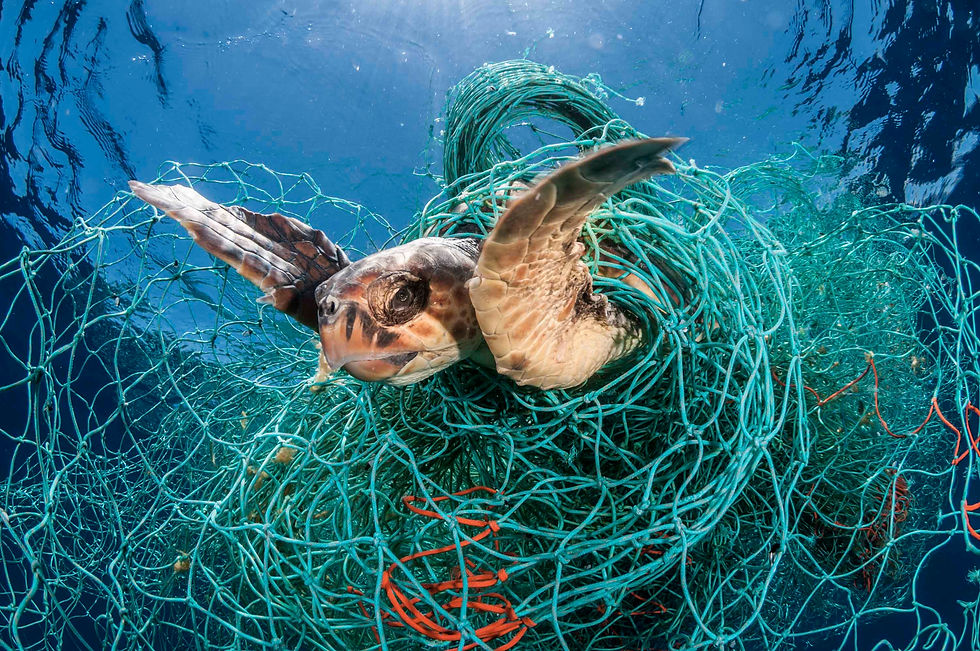
Take the ECONYL® yarn created by Balsan using recovered fishing nets which are recycled by Aquafil using their innovative ECONYL® regeneration system, which depolymerises them and transforms them into nylon fibre which can be transformed into carpet. Saving our wildlife and removing waste that would otherwise take centuries to degrade.
Sticking with a marine theme, Seastex develops high-performance acoustic tiles and insulation from waste mussel beards (byssus) using material that would otherwise go to waste to create something useful.

Whilst visitng Surface Design Show I was introduced to Pierre Plume. They have developed a design-led acoustic surface from recycled textiles, ‘Pierre Plume Plush’ although something out of 'Toy Story' nightmares, using unwanted teddy bears, soft toys and dolls clothing materials otherwise destined for landfill and recycles them into beautiful sound absorbing panels.
Another interesting use of recycled materials I saw on the Surface Matter stand was bank notes. What happens when money loses its worth? Plasticiet created an installation for the Bank of England highlighting the journey of banknotes removed from circulation, shredded and reconstructed into architectural and symbolic forms. Further highlighting how design reimagines value; from financial permanence to material transformation.
These kinds of innovations show that waste materials can become beautiful, durable design solutions, rather than simply being hidden away in landfill.

THE PROBLEM WITH GREENWASHING
Sustainability has become a huge talking point in our industry - and rightly so. But alongside genuine progress, we've also seen the rise of something less helpful: GREENWASHING.
Many products are now marketed as "sustainable", "eco", or containing "recycled content". But when you look a little closer… (and this has really stuck with me from Solus' RIBA certified CPD on sustainability, to “always ask questions” - thanks Ken Graham) that claim can sometimes mean something very different from what we assume. In some cases, the "recycled" element may simply refer to water reused during the manufacturing process rather than the product itself being made from recycled material.
Or virgin plastic bottles rather than post-consumer waste.
As designers, we have a responsibility to ask deeper questions:
What is this product actually made of?
Where do the materials come from?
How is it manufactured?
And crucially, what happens at the end of its life?
Some manufacturers are starting to address this with take-back schemes, allowing furniture to be returned for refurbishment or recycling. Dutch furniture manufacturer Casala, for example, guarantees take-back and recycling for its furniture, even after more than fifteen years of use, ensuring materials can re-enter the production cycle.
This kind of thinking moves us away from a linear "make-use-discard" model and towards a circular economy.

DESIGNING WITH CARE
At a recent design talk at Surface Design Show, a phrase that stuck with me was "designing with care."
Care means thinking about the entire life cycle of a product.
When specifying a chair, table, or piece of joinery, we should be asking:
Can it be taken apart and recycled?
Are the materials separable, or permanently bonded together?
Can the upholstery fabric be reused, recycled, or repurposed?
Could materials go on to have a second life, perhaps as insulation, underlay, or another product entirely?
These questions don't just shape a more sustainable project - they shape a more thoughtful one.
These questions might seem small at the specification stage, but multiplied across an entire industry they could make a big... HUGE difference.
THE COST CHALLENGE
Of course there’s another reality we face in the industry: BUDGETS!

There are companies doing fantastic work, collecting unwanted furniture, refurbishing it, donating it to community projects or responsibly recycling materials. But these services often come with a cost, and when project budgets are already tight it can feel difficult to prioritise them.
But perhaps we need to rethink that perspective. What might seem like a short-term cost could actually be an investment in the future of our industry.
If we want the next generation of designers, makers and builders to prioritise sustainability, we have to start setting the precedent now.
The decisions we make today, about materials, suppliers and design longevity, shape the standards of tomorrow.
A MORE CONSIDERED FUTURE
Creating a more considered approach to interior design means balancing creativity, client needs, budget constraints and environmental responsibility.
It means asking harder questions.
It means designing spaces that are not only beautiful and functional today, but thoughtful about their future.
Because the real challenge for designers is no longer simply creating the next trend.
It's designing interiors that outlast them.
Loved this Annie — such a great read. The idea of the “anti-trend” really resonates, especially designing spaces that can evolve instead of constantly being replaced. Also fascinating to see how waste materials can be turned into such creative design solutions. Really thoughtful piece!
Fabulous article, Annie—really insightful. There’s certainly a lot of “greenwashing” out there, which is disappointing given the growing focus on sustainability. Sometimes people genuinely believe they’re making the right choice by selecting sustainable materials, only to be let down by aspects of the manufacturing process, such as the use of certain glues or chemicals. Hopefully, as the industry continues to evolve, these processes will improve and lead to truly sustainable products end to end